Sunday, December 31, 2006

What About...Masks?

I had a mini-revelation last night. I'm still not sure if it's a viable idea, but I think it has the potential to solve two big birds with one semi-simple stone. Bear with me as I tease this out.

First, the practical production problem: we still lack a costume designer, and it's becoming increasingly clear that no one is willing to take on the responsibility when the cast is so big, the costumes are period, and the Walterdale wardrobe has so little from that era. Everyone agrees that Antony & Cleopatra deserves to be a sumptuous visual spectacle...but no one is willing to take charge of that sumptuousness (at least not where costumes are concerned).

I've been wracking my brain trying to come up with a fix for this. One option is to set the production in a different period altogether -- some historical or contemporary setting that Walterdale already has ample supplies of in our wardrobe. But a decision like that requires an equally strong artistic concept backing it up. There's nothing worse than a Shakespearean production wallowing in post World War I Europe or floating in some vaguely medieval limbo if there isn't some strong, supportable reason for connecting that play with that period. Modernizing the play is also fraught with problems, because then you have to explain the presence of swords amidst 21st century battle gear (or else use the word "sword" to describe the machine guns in everybody's hands). In any case, nobody wants to see Cleopatra in a modern evening gown; they want to see her in her own historical grandeur.

However, a clever designer has a bit of an out, here, because most people don't know exactly what that historical grandeur is supposed to look like -- only that it's not like anything we see today. Most theatregoers have a vague sense of Roman attire, but Egyptian fashion? Hard to place. They could involve a lot of gold, like Tutenkhamen's sarcophagus; or they could involve brightly coloured, flowing fabrics, like images of Persian or Arabian cultures; or they could be quite simple, like the white cloth tunics seen in most hieroglyphics. (Historically, Cleopatra probably dressed more like a Greek noblewoman than an Egyptian goddess.)

Where am I going with this? I'm dancing around the notion that Egypt and Rome can be signified by relatively simple and basic images -- a coloured fabric here, a tunic there, maybe some gold jewelry, and so on. But that doesn't account for the rest of the clothing (actors need to wear something, after all). Nor does it provide the spectacle which audiences expect with a play like this.

I'll get back to this problem in a moment. In the meantime, there's another challenge, this time of an artistic nature. It involves the tension between characters' public and private personas -- a tension which pervades the play, as Antony & Cleopatra struggle to resolve their private love for each other with their public responsibilities to their respective realms. There are a number of ways to demonstrate this tension onstage -- through voice, through physical stance, etc. -- and I suspect I'll draw on most of them at different points in the action.

But what if there were a way to clearly delineate the public/private faces of these characters while also injecting a hefty dose of visual spectacle and theatricality? And even make it fun for the actors?


Greek and Roman theatre employed masks to identify character types, and to amplify and broadcast emotions onto a grand tragic (or comic) scale. Their masks represented public, easily recognizable figures -- the Hero, the Soldier, the Lover, the Old Man, the Clown -- and those characters were expected to behave according to particular parameters. Like Antony the public figure or Cleopatra the queen, those masked characters had scripts, and if they deviated from those scripts, then their audiences would rebel.

Most modern productions that employ masks use them for similar ends. They usually either use masks 100 per cent of the time, or not at all. But what if a character could be masked in public, and then remove that mask in private, intimate scenes? It would become a sort of badge of office, like a helmet or a crown. It would also give characters a physical focus for their debates about public vs. private responsibility. Imagine Antony saying, "These strong Egyptian fetters I must break / Or lose myself in dotage" while raising his "Roman" identity up to his face, to cover up the naked, honest emotions that reveal him as a human being.

What about the costume problem? Adding masks doesn't resolve this issue, but it might give us the artistic flexibility we need to simplify our design concept to a manageable level. The masks are a "conceit," an artistic abstraction that informs the audience, right from the start, that we're not 100% in the real world. Once you've telegraphed that sort of abstraction, you can afford to make other adjustments, too. You could, for instance, make the base costumes more neutral (timeless, colourless robes or tunics, for example), and then use individual costume items as signifiers (as mentioned above).

So, in theory, the masks could solve a very problematic production issue and an artistic challenge in one fell swoop. They're not without their own challenges, of course -- mask construction takes time, and can be messy -- but this is the first idea I've had in awhile that seems to really open up a wealth of performance possibilities.

Thoughts?

Monday, December 18, 2006

A Cast At Last!

Our call-back read-through was tonight; it was exciting, but also nerve-wracking; I felt like I was auditioning as much as they were, plus I had to make some very tough decisions about casting. I hope I didn't disappoint anyone too much; but I am certain we have an amazing ensemble cast on our hands!

Here is the cast of A&C 2007:

Kelly Aisenstat (Lepidus / Philo)
David Cairns (Pompey / Silius)
Bonni Clark (Octavia)
Nathan Coppens (Menas / Scarus)
Denny Demeria (Ventidius)
John Dolphin (Antony)
Erik Martin (Agrippa)
Kieran O'Callaghan (Enobarbus)
Jennifer Peebles (Mardias)
Cody Porter (Octavian)
Monica Roberts (Cleopatra)
Matt Robertson (Gallus)
Erin Voaklander (Alexas)
Natasha Weenk (Eros)
Leah Wilburn (Iras)
Beverly Wright (Charmian)
Philip Zinken (Menecrates / Thidias)
TBA (Chorus, Soothsayer, Clown)

Wednesday, December 13, 2006

Auditions, Day Two

Another good night on Monday, and a lot of fierce discussion afterwards with Sarah and Jenn. Who's Antony? Who's Cleopatra? Who's available when? Who do we want to work with? Well, we'd like to work with everyone, but ultimately it comes down to questions of chemistry and compatibility. Who do we think will work well together--or look good together?

I wish I could provide all the answers, but I don't have them--not quite yet. We'll have to wait until the call-back on Monday to finalize the cast. We'll read through the script and I'll try different actors' voices off each other. It will be a bit nerve-wracking, waiting until then--and I can only imagine how the actors must feel!

But soon, very soon, we'll have a cast. And no matter how the chips fall, I think, it'll be an awesome one.

Sunday, December 10, 2006

Auditions, Day One

Tonight we had the first round of auditions for A&C. We saw 16 people (plus one early bird I saw yesterday because she couldn't be here tonight or tomorrow) -- and I'm aiming for a cast of 18, so in theory, we should have almost everyone we need.

Except...the ratio of female to male auditioners is, perhaps unsurprisingly, skewed. Every gal wants Cleopatra...and who can blame them? I had to beat the bushes a wee bit to get men out to the auditions. And it paid off, to some extent. In the end, it turned out to be a very fine evening. I saw a number of familiar faces (some from King Lear or other recent Walterdale shows) and a lot of delightful surprises from newcomers. In a way, I could cast the show from what I saw tonight. I'd just have to cross-cast a lot of actresses as tough-guy Roman soldiers (or politicians...or pirates ... hmm, lady pirates...).

I can't, of course, make any decisions until I've seen everyone. And it's hard to picture most of the supporting roles until I know exactly who is going to be playing the leads, especially the big three: Antony, Cleopatra, and Octavian.

But if tomorrow proves as profitable as tonight, I will have an abundance of talent to choose from. In fact, I may have to make some tough, tough choices...

Wednesday, November 29, 2006

Hide and Seek

Here's a great practical example of how knowledge of the set design can help to solve a director's challenges, while simultaneously opening new avenues of exploration.

Antony & Cleo enter about ten lines into the play proper. Prior to that, a Roman soldier (Ventidius in my version) is moaning about how Cleo has turned Antony into a simpering girly-man instead of the mighty soldier he should be. When the two of them enter, they start talking about (what else?) their love. Cleo asks Antony to measure it for her; he cleverly evades this trap, and so on:

CLEOPATRA: If it be love indeed, tell me how much.

ANTONY: There's beggary in the love that can be reckoned. (or "measured" in my version)

CLEOPATRA: I'll set a limit on how far to love.

ANTONY: Then thou must needs find out new heaven, new earth.

The challenge is this: how do they enter? Side by side? Arm in arm? Or does Cleo walk ahead of Antony--since she is the Queen here, after all, and since she has the first line? Or should Antony lead, with Cleo following, begging for his love--putting the lie to what Ventidius has said about his diminished power?

Obviously, Shakespeare is no help in resolving this. Directors and actors can debate endlessly about who has the status, and how the audience should first be exposed to these central characters. The possibilities are almost limitless...

...until you have a set. And in our set, the central entrance is covered with an archway and a screen, which means that actors must walk around one side or the other (which I'll be calling Upstage Right and Upstage Left from now on) before they are visible to the audience. And since there are also pillars set along each side of the arch, the entryways are only about four feet across.

Now, having A&C enter side by side or arm in arm becomes a challenge. Not only do you have to decide which side of the arch to bring them in, but you also risk having them squeeze together most undecorously in order to get through the entryway. A grand, processional entrance is effectively out of the question.

So, one leads and the other follows? But which side of the arch do they enter from? A non-centralized entrance effectively weakens the impact of both characters. And (unlike my production of Lear last year) this play really doesn't feel like it moves in curves and spirals--it's more of a straight-on, right-angle kind of show. How can you bring on two characters from a non-centralized entrance but still have them dominate the stage?

The solution is practically self-evident. They enter at the same time--but they enter separately, coming around either side of the arch, creating a centralized movement between the two of them. This works visually, and it starts to say something about the characters as well (the fact that they treat each other as equals). But does it make sense to have two characters enter in mid-conversation, but from different entrances? How could that be explained?

A glance ahead a few pages provides the next solution. After the two of them have exited, Cleopatra re-enters (this is Act 1, Scene 2 in the original, although it will play straight through in my version). To Enobarbus, she asks, "Saw you my lord?"

ENOBARBUS: No, lady.

CLEOPATRA: Was he not here?

CHARMIAN: No, madam.

CLEOPATRA: He was disposed to mirth, but suddenly
A Roman thought did strike him.

Then, moments later, when Antony does arrive, Cleopatra characteristically changes her mind, and exits, saying "We will not look upon him."

What's going on here? Isn't it obvious? They're playing hide and seek. Although Antony's goals have started to shift (having received some upsetting news from Rome, as Cleopatra implies), Cleopatra continues the game, scurrying off as soon as Antony re-enters.

Applying this idea back to their first entrance, I find it delightfully concordant with the constraints of the set. The characters are engaged in an ongoing discussion (about their love), but they are also involved in an ongoing game of chase-me, chase-you, using the entire palace (or all of Alexandria) as their playground.

Obviously, this choice supports Ventidius's opinion (that Antony is not behaving like a soldier). But, curiously, it refutes his idea that Antony has somehow become subservient to Cleopatra. He is not "a strumpet's fool" if both of them are acting like fools to the same degree. The entrance will suggest fresh, unbridled love--but not, I think, in any way which will diminish the participants.

I love it when solutions just happen.

Sunday, November 26, 2006

Blocking Friezes

Earlier, I mentioned that I'd decided to add chorus speeches to the beginning of each act (since there will only be one intermission, there are only two acts in my version of the script). But I wanted to keep these speeches dramatic, somehow, so that the play did not begin with bland exposition. This is a bit of a balancing act; if you include a bunch of dumb-show action upstage during a speech, then your audience's focus will get split, and they won't hear the information you're trying to convey.

Thinking about the set design, I realized I have an opportunity for a sort of compromise--something half-way between an empty, lifeless stage and a bunch of action. See, the upstage walls will be backdrops, with pillars running a few feet apart from one another. The gaps between the pillars aren't quite wide enough to act as a "frame" for an entire tableau. But what if the space between each pillar could act as part of a frieze--that is, a series of frozen images (live actors in tableau) that unfold to make a story?

There are hundreds of examples of what I mean from classical artwork. A Greek or Roman vase will usually contain a story, told in a series of still images. Egyptian heiroglyphics do the same thing. A more modern equivalent would be the panels on the page of a comic book: each one tells a little bit more of the story; they're mostly visual, although they would work in tandem with the chorus to provide a complete narrative of past events.

Each upstage wall has three pillars, which means four spaces. How do you tell the "story" of the assassination of Julius Caesar in four still images? Keep in mind that each one could not involve more than a couple of people.

Panel One: Caesar enters the capitol, wreath on head, hand up, triumphant.
Panel Two: Brutus and Cassius stand close together, daggers peeking out of their togas.
Panel Three: Cassius stabbing Caesar. Caesar still stands upright, shock and rage on his face.
Panel Four: Now Caesar on his knees, Brutus poised to stab him. Caesar's disappointment and betrayal.

Of course, in the version of the chorus I have currently, this entire sequence of events is described in a two lines: "For, after Caesar cravenly was stabbed, / Betrayed by Brutus and his fellow blades--" So maybe it would be asking too much of the actors (and the audience) to move so quickly through so many panels. In which case, one might need to summarize the whole play of Julius Caesar instead:

Panel One: The assassination: Caesar and Brutus
Panel Two: Caesar's corpse, with Mark Antony crouching over it, thinking of vengeance
Panel Three: Caesar's ghost stands over Brutus. Brutus, racked with guilt, holds his sword above his own chest.
Panel Four: Antony stands over Brutus's body, maybe with Octavian as well

Or something like that. I might also incorporate the silhouette screen; we'll have to see. But I am intrigued with the "living frieze" idea--like ancient illustrations coming to life on stage.

Sooner or later, I'm going to have to stop mucking about with the chorus and get down to thinking about the actual play...

Tuesday, November 21, 2006

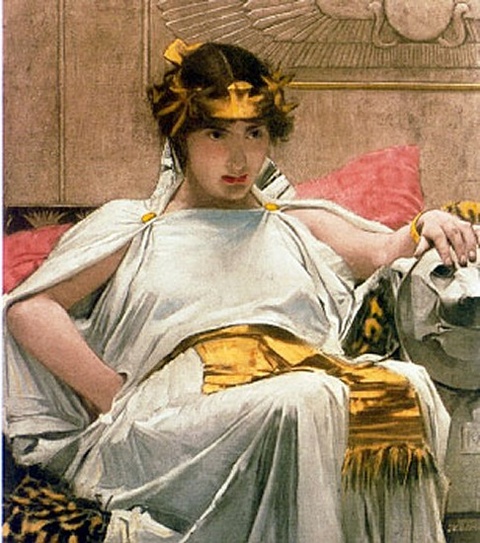
Images of Cleopatra


I've been looking for neoclassical artwork--trying to find ways to incorporate their strict geometric compositions into my blocking (because, you know, I'm a masochist). Out of curiosity, I did a search for images of Cleopatra herself.

Fascinating to see how different eras interpreted this protean character. It seems like she could transform to suit the needs of just about any artistic movement.

Here's one I like by John Waterhouse (a pre-Raphaelite, though strongly influenced by neo-classicism).

Sunday, November 19, 2006

Chorus

Antony & Cleopatra doesn't have a Chorus. None of the Roman plays do, as Shakespeare preferred to use lower-class characters (citizens, servants, or, in the case of A&C, footsoldiers) to discuss current events. Thus, Act 1, Scene 1 of A&C begins with one of Antony's soldiers, Philo moaning to his friend Demetrius about their general's unmanly conduct in Alexandria:

PHILO: Nay, but this dotage of our general's
O'erflows the measure. Those his goodly eyes,
That o'er the files and musters of his war
Have glowed like plated Mars, now bend, now turn
The office and devotion of their view
Upon a tawny front. His captain's heart,
Which in the scuffles of great fights hath burst
The buckles on his breast, reneges all temper
And is become the bellows and the fan
To cool a gipsy's lust.

The advantage of this dialogue-based opening is its dramatic momentum. It's driven by characters who have objectives--unlike a Chorus, whose only motivation for speaking is to inform the audience. It's a much punchier way to start a play, and most of Shakespeare's masterpieces begin like this (Hamlet, Othello, and perhaps most successfully, Macbeth).

The disadvantage is a greater risk of audience confusion. At lights up, they don't know who these two characters are (their costumes might identify them as Roman soldiers, but whose soldiers? And where are they?), and we don't know who they're talking about--"our general" in Line 1 refers to Antony, but since the characters both know who their general is, they have no practical need to identify him by name. Same with Cleopatra, who is referred to twice in the above speech: once as a "gipsy" and once as a "tawny front." These semi-derogatory terms are perfectly in character for the resentful Philo, but they don't serve the audience's first, most pressing need: to know what's going on, and who is being discussed.

There are several justifications for this potential ambiguity. The first is that Shakespeare's original audience would have been more familiar with these terms--they would have understood, for example, that "tawny" and "gipsy" both refer to Cleopatra's dark skin colour, which distinguishes her from Roman women. The second is that Shakespeare's audience knew more about the historical situation than most modern audiences do. This point is debatable; but at the very least, Shakespeare's audiences had already seen his play Julius Caesar, so they knew about the events leading up to A&C. Modern audiences are, sadly, out of touch with their classical history, and JC isn't produced as often as it used to be.

The third justification for Shakespeare's ambiguity is unapologetic: he enjoyed starting off a play with a mystery. If you force yourself to forget everything you know about Hamlet or Macbeth, and then read the first few pages of Act 1, Scene 1, you'll see how much is left unsaid. Ambiguity and mystery is one way of drawing an audience into the world of your play. And, in any case, the ambiguity about the "general" and the "gipsy" doesn't last long: within 10 lines, the two characters arrive on stage and begin acting out the passion that Philo is describing.

None the less, I am concerned enough about the play's beginning to have done the unthinkable: I've added to Shakespeare's script. I feel that A&C has altogether too much backstory, and that Shakespeare doesn't spoon-feed it to his audience (which is good), thus running the risk that modern audiences will tune out in frustration (which is bad). I could solve the problem in the same way that many other productions do, by writing some program notes; and I may do this as well.

But I've had some experience writing faux-Shakespearean verse, so I thought I'd try a more active solution. Starting off the play with a Chorus loses that dramatic immediacy; but it gives the uninitiated audience members some common ground, so that they are not dropped into totally unfamiliar territory. In fact, it struck me that a modern audience might like to have things start off with a familiar image: the assassination of Julius Caesar. Even those who haven't seen a production of Shakespeare's JC know about this historical event--and A&C emerges fairly directly from that incident. You need only mention Brutus's civil war and the establishment of the Triumvirate, and you're pretty much good to go.

Here's what I came up with. I haven't yet decided if I will have the speech accompanied by dumb-show scenes, or tableaux, or even slide projections--one way or another, it would be nice to give it a bit more dramatic motion. I'll probably write a Chorus piece for the top of the second act as well (approximately Act 3 in the original).

CHORUS: I dreamt there was an Emperor Antony.
‘Twas never so; not in our history.
For, after Caesar cravenly was stabbed,
Betrayed by Brutus and his fellow blades—
(A tale which our own author has described,
And many stages shown)—then there was war,
And Caesar’s spirit, ranging for revenge,
Did prowl the battlefield, and turn the swords
Of his assassins, guilty, on themselves.
Then rose in Rome a great confed’racy
Between three princes—the Triumvirate.
Great Caesar’s nephew, called Octavian,
Remained in Rome; and with him, Lepidus,
A grey reflection of an aging empire.
The third, Mark Antony: right hand of kings,
A peerless match in politics and war—
Brave Antony set forth to gird the borders
Of the sprawling Roman realm. Brave Antony,
Whose honour vaulted over mountaintops,
Whose majesty could have commanded all—
But first, he sailed to Egypt, where he met
The one force which surpasses honour, might,
Ambition, duty, death, the gods above—
In Egypt, mighty Antony met love.

Thursday, November 16, 2006

Set into Motion

Last night, I met with Sarah, the assistant director, and Alli, the set designer. Alli had a maquette of the set done up for us to admire. The simple, scale model, with its pillars and backdrops of construction paper, were more than enough to re-engage my imaginative brain. I realized that what was holding me back (other than an insanely busy schedule) was not knowing how everything would look. Obviously, I'll need other pieces of the puzzle--costumes, props, and oh yeah, actors--but having a set to play with in my mind is an important start.

The Walterdale Playhouse stage is a wedge, of sorts--a great big curved apron downstage, narrowing to a corner directly upstage. The back walls are brick, but they will be covered by backdrops, constructed out of flats and painted to resemble a vast, Mediterranean sky. In front of this broad backdrop, two rows of pillars (one might be painted onto the backdrop itself, but at least one row will be real). Upstage, the pillars will converge upon an arch, which from the sounds of things will contain a sort of screen, used to receive projections (more on this below). The arch-and-screen will cover the upstage exit (so it becomes, in effect, two entrances, as characters can come in around either side of it). There are also exits to the lobby on stage right and stage left, plus I talked Alli into adding a couple of "servant's exits" along each side of the backdrop. This makes a total of six entryways, which is plenty for my purposes.

The stage floor will be painted to look like water, possibly reflecting the pillars. Mostly, the centre & downstage space will be bare, but Alli has added one more set piece--a large trapezoidal block, about 5 feet wide and 3 feet high at its largest end. Based on the model, it looks like a cross between a divan and a sarcophagus. It's also sloped, so that it can create the effect of, say, a gangplank. Basically, it's a multi-purpose set piece, and once I convinced Alli to make it able to rotate, I began to see a million different uses for it. There aren't many moments in the play where characters have to sit or lie down (although Cleopatra could certainly afford to do some reclining from time to time), but having actors use the block for height and status could be very useful.

I mention the gangplank in particular because one of the challenges Alli was trying to resolve was the scene on Pompey's barge (it's Act 2, Scene 7 in the original, or Unit 16 in our script). In my revision, Pompey meets an untimely (and fictional) end, getting his throat cut and his body dumped overboard. The need to have an "overboard" onstage--that is, a thing behind or beneath which one could fall--led Alli to create the trapezoidal block (although there's not really much space behind it, so Pompey would still likely be visible to the audience once he fell).

But in a Shakespeare play space, like time, is fluid. The stage can represent a ship in one scene, and then dry land in the next--or can even shift within a single scene. And when I started to think about the possibilities of some of the other parts of Alli's set, I realized that a literal throat-cutting and overboard-dumping may not be necessary, or even ideal. I'm thinking now about that aforementioned screen upstage.

Roy Jackson, our lighting designer, is intrigued by the possibility of having projections be part of the show--possibly to reflect the shift in settings, or else simply to convey thematic moods. I like the idea, but once I saw the screen, I started to think about other ways in which it could be used. Two of my previous Shakespeare shows (Macbeth and Othello) have used back-lighting techniques to good effect. There's just something about the menace and anonymity of silhouettes and shadows that evokes the tragic mood. So I suggested to Alli that, when the screen wasn't being used to receive front-projected images, it might instead be used to receive back-projected silhouettes.

I haven't thought the idea through completely yet, but off the top of my head, there are at least two moments that could really benefit from being back-lit, instead of enacted directly onstage. The first is Pompey's murder: for one thing, a throat-cutting is far less effective onstage, when there's no blood; and, as I said, dumping the body becomes much easier when you don't have to worry about where the body ends up. With back-lighting, an actor can easily drop down beneath the throw of the lighting instrument, effectively disappearing from the projected image. Add in a "splash" sound effect, and you've got your dumped corpse.

But the other back-lighting moment that sprung to mind is, I think, the most profitable discovery of the evening. For weeks now, I've been going back and forth on one key question: to snake or not to snake? In other words, what should Cleopatra use as an asp in her death scene? In an intimate setting, rubber fake snakes ain't gonna cut it; they'll defuse the tension and grandeur of the moment in a heartbeat. But a real snake is infinitely more problematic for all sort of reasons. Even if there weren't any ophidiophobes in my cast, you can bet that, some night, someone in the front row will panic when that snake comes out. And sooner or later, you know it's going to escape from its cage...

What I need, then, is the illusion or suggestion of a real asp. And if I can't get that onstage, then the next best thing is to do it through back-lighting. I imagine Cleopatra proceeding up, behind the arch, in a stately fashion, speaking her lines...and as the back-light comes up, we see her lift her hands up, and we see the (rubber) snake twisting in her (expertly rehearsed) fingers... and if we never see the snake itself, then it will stand out that much stronger in our minds.

So that's the new plan. I still need to go back and examine the text, to see if that staging will work. And there are still plenty of other blocking challenges ahead--sequences I plotted out in my mind without knowing what my set would look like, which I now need to re-block (or even re-edit). But I've got a lot to play with, now.

Thursday, October 19, 2006

Our Masthead

Still very busy, but I have good news: Antony & Cleopatra finally has a production manager! Theresa Kind, who stage managed my Fringe show, has agreed to take on this vital task. Along with the director and the stage manager, the PM is one of the "holy trinity" of any theatre production; it is her job to gather designers and technicians and to supervise production meetings and budgetary issues. Hopefully, her arrival will make the team-building process much smoother and less stressful.

Speaking of our team, here it is, at the moment:

Director: Scott Sharplin
Assistant Director: Sarah van Tassel
Production Manager: Theresa Kind
Set Designer: Alli Ross
Lighting Designer: Roy Jackson
Sound Designer: Phil Kreisel

(I apologize if I've forgotten anyone!)

Saturday, September 23, 2006

Full Speed Ahead, Slowly

A long-overdue update: I've been busy, but A&C has not been my priority. The school term started three weeks ago, and I have a nearly full course load this year, teaching a couple of courses I haven't taught before. Busy, busy, busy.

Walterdale's season is also getting into gear, and there's an exciting buzz about the Playhouse. Our first show, Steel Magnolias, opens in just under a month, and from all reports, it's going very well. The cast and director are having a grand old time. We've also just finished casting Show #2, A Child's Christmas in Wales. The casting process was a bit stressful for me, because our director came on board rather late, and we still don't have a Musical Director (Interested? Know anybody? Give me a shout).

Plus, the show calls for a lot of children--which I somehow never realized until we were in the thick of auditions. I haven't worked much with kids--at least, not since I was one of them--so I felt a bit overwhelmed. But a quick trip to Vic, my old stomping grounds, reassured me; even though I'm no longer a kid, I still share the same enthusiasm for theatre that I had when I was 16. It gives me and the kids something in common, which makes me feel young.

Anyway, that show is cast, and rehearsals have begun. One more round of auditions (the hotly anticipated Les Liaisons Dangereuses), and then it's finally time for A&C to find a cast. In the meantime, I have confirmed Roy Jackson as our lighting designer, and welcomed Phil Kreisel on board as sound designer. Still required: a Production Manager, Stage Manager, Master Builder, and Costume Designer. Keep your eyes peeled!

Thursday, August 31, 2006

Fringey Come, Fringey Go

Sorry it's been awhile. I got distracted by (of all things) theatre -- a lot of it. The 25th anniversary Edmonton Fringe Festival wrapped up this weekend, and I'm only now starting to reorient myself and look towards future projects.

It was a great Fringe, by the way. Not only did my own play, Purity Test, receive a lot of good reviews and popular acclaim, but a lot of other local shows got showered with praise as well. It's a bit pointless to provide full coverage after the fact, but just for the record, some of the shows I enjoyed included How I Learned to Drive, Down Dangerous Passes Road, Tales of Death, Finer Noble Gases, How Not To Suck (featuring former Walterdale AD Sam Varteniuk), and Catch/Jolly Jumper. I also had a good time at the Fringe Forums, where artists and aficianadoes got together and debated the past, present, and future of Fringe.

In the midst of all this theatrical madness, plans were quietly being laid for Walterdale's next season. The new website is now up, and it looks lovely: you can visit it at www.walterdaleplayhouse.com. We're also just about to have auditions for our Christmas show, which is a musical adaptation of A Child's Christmas in Wales. Auditions are on September 10 and 11; if you want to come and try out, email Janet at j1h2a3@shaw.ca.

Antony and Cleopatra is still on my radar, but I doubt I'll have a lot of time to think about it soon, since I'm also just about to start my teaching term at Grant MacEwan. But when thoughts escape, I'll direct them here.

Tuesday, August 15, 2006

Utah vs. Stratford

To add insult to injury, my wife just got back from a lengthy stay in England, during which she saw two productions of Antony & Cleopatra--one at the New Globe in London, and one in Stratford-on-Avon, starring the mightly Patrick Stewart! Both productions were strong ones, the Stratford show in particular. Sheila very considerately brought back programs, posters, and postcards from both shows--and will be providing detailed reports on both shows. But it's still ironic, I think, that we both flew out of Canada and saw A&Cs, and I ended up with the short end of the stick.

Saturday, August 12, 2006

Utah, Part 2

In my last post, I outlined some of the things that went wrong in the Utah Antony & Cleopatra. Here's one or two things they did right:

--The relationship between Octavius and Octavia. Even though neither actor was very strong, the director used blocking to communicate Octavius's reluctance to let his sister become Antony's wife. This is easy to overlook; but Octavius isn't the one who suggests the marriage (Agrippa does), and he spends almost exactly the same amount of time bidding farewell to Octavia as Antony does in a later scene (when he's planning to return to Egypt). The director kept having Octavius interpose himself between Octavia and Antony, until finally the frustrated Antony, crying "Come, sir, come, I'll wrestle with you in my strength of love" grabs Octavius and pulls him away. He turns it immediately into a joke, but it also served to reinforce Octavius's dislike and fear of Antony.

--Also, calling "Octavius" "Octavian." It's easier to say, especially the possessive.

--The scene in which Cleopatra learns that Antony has remarried (2.5), and the scene in which she quizzes a messenger about Octavia's appearance (3.3). Lots of inherent comic irony in these scenes, and a chance to show both the best and worst sides of Cleopatra. In Utah, the messenger was a great comic actor, easily tempted by offers of gold, and then terrified when he thinks he's said the wrong things. In 3.3, he kept looking back to Charmian and Iras before answering Cleopatra's questions:

CLEOPATRA: Is she as tall as me?
MESSENGER: She is... [Behind Cleopatra, Charmian and Iras shake their heads] not, madam.
CLEOPATRA: Didst hear her speak? Is she shrill-tongued or low?
MESSENGER: Madam, I heard her speak; she is... [Charmian and Iras gesture to the floor] low-voiced.

This went on until the Messenger, getting cocky, said, "And I do think she's thirty" in a sneering tone of voice that suggested any woman over thirty must be a hag. Cleopatra grew cold, and the Messenger tensed up, expecting another violent assault like the one in 2.5.

--The Soothsayer. In Utah, he was tall and thin, with dark circles underneath his eyes. He spent most of his scenes staring up at the sky (which, in the open-air pseudo-Globe, actually contained stars), and only reluctantly read Charmian and Iras's palms. His presence alone onstage book-ended the production, as if he were a reticent sort of chorus figure. But more interestingly, he reappeared twice in the second half of the play: once as part of the "hautboys" scene, and again disguised as the clown who brings Cleopatra's asps.

The "hautboys" scene (4.3) features Antony's night watchmen reacting to strange, ethereal music (according to Shakespeare's stage direction, "Music of the hautboys under the stage"--hautboys are like oboes). One soldier declares, "'Tis the god Hercules, whom Antony loved, now leaves him." In Utah, they gave this line to the Soothsayer--very clever, I think, since no ordinary soldier should be able to read such omens or portents.

As for the Soothsayer/Clown doubling, I had already planned to do that for practical purposes; but now it occurs to me that it might be valuable to make it plain that the Soothsayer is providing Cleopatra's means of achieving immortality. His lines are goofy (and not terribly funny, although the Utah audience did chuckle once or twice), but I think they could be delivered with a hidden earnestness that suggests the speaker knows Cleopatra's plan.

Humour in the play is a problem which I'll have to address sooner or later. I was very pleased with how much levity I could wring from King Lear--but then, that tragedy has a Fool as one of its major characters (for the first half of the play, at least). In this play, we have one Clown in one short sequence near the very end of the play--not enough laughter. Enobarbus may draw out a few guffaws, but even he gets pretty serious in a hurry.

Thursday, August 10, 2006

Egypt in Utah

Just got back from a three-day Shakespeare conference in Cedar City, Utah. I presented a paper on "Hamletmachines and CyberDanes" (something from my grad studies), but the main reason for going was not the paper, nor any of the other academic shenanigans. Mainly, I wanted to check out the Utah Shakespeare Festival, and in particular, to see their production of Antony & Cleopatra.

You see...big confession here...I'd never actually seen a live performance of the play until now. Hence the need to fly 500 miles (including one hop in a tiny twin propeller plane) to the hot red desert (not Egypt; the other one).

How was it? Well, Cedar City is pretty...and the conference was OK, although there were only a handful of papers about A&C--most of them dealing with film & TV versions, not stagings. The Shakespearean theatre was lovely, a quaint, open-air riff on the original Globe (without the "pit" for groundlings to stand in). I saw a very fun production of Merry Wives of Windsor...

And then there was A&C. Oh, dear. What a travesty. Antony was a hulking boor with a radio announcer's voice and a tendency to sway, as if drunk, even at the character's most sober moments. Cleopatra was a strong actress (she'd done a great job as Mistress Quickly the night before), but she seemed unfocused, shiftless--generally lacking in either authority or sex appeal. Octavius was similarly vague. Octavia was unspeakably bad. And the costumes...oh my god... it was like they threw every style from East Indian to Cavalier England into a tie-dye machine.

But a show with a few bad actors and a nightmarish design concept might still be saved, if the director knows what he or she is doing. This guy didn't. As a result, the blocking was mostly unmotivated (and poorly suited to the thrust stage), and the actors' gestures lacked specificity and realism. This trend reached its nadir when Cleopatra plucked a rubber asp out of the basket and held it like it was...well, a rubber toy, instead of a deadly serpent or her ticket to immortality.

Yipes. Just yipes.

For all that, there was a handful of interesting moments, and I feel no remorse about stealing or adapting them into my own production, mainly because I can't help feeling they were either accidental, or ripped off themselves. I'll describe a few of them shortly. I also have some reports from Sheila, my wife, who just got back from England, where she saw two productions of the play (at Stratford and the New Globe), both light years better than the one I suffered through.

Monday, July 31, 2006

Lighting Designer

Another team member has come on board for Antony and Cleopatra: our lighting designer is none other than Roy Jackson, Walterdale's technical director and the guy who knows that venue better than anyone on earth. I think Alli's set and Roy's lights will make for an outstanding combo. Slowly but surely, the big picture comes into focus.

Thursday, July 27, 2006

Cleo the Goddess

Slowly reading Michael Grant's biography of Cleopatra. Early on, he describes the Ptolemaic dynasty of which Cleopatra was a part -- a Greek dynasty, descending from Alexander the Great, but having adopted many of the customs and beliefs of their Egyptian surroundings. One of these beliefs was that monarchs were the earthly manifestations of gods and goddesses -- both Greek gods, like Dionysus, and Eygptian ones, like Osiris and Isis (being the manifestation of more than one god sounds like a lot of work to me, but nobody said it was easy being queen!).

There are obvious political reasons for associating oneself with gods, but the practice had been ongoing for so long (inherited from the Pharoahs) that I can't help but wonder if the Ptolemies believed their own hype. Particularly someone like Cleopatra, who was born and raised to believe her father was the mortal embodiment of Dionysus, and that she would one day become queen, and therefore, a goddess also.

This seems relevant to the play, not because it feeds Cleopatra's ego (no need for help there), but because it reinforces the "immortal longings" which motivate her suicide. I keep coming back to that moment because -- well, partly because I'm afraid of it, but partly because it epitomizes the "larger-than-lifeness" that the play seems to demand. If Cleopatra has always believed that she was destined for godhead, then her decision to die may be misinformed, but it is far from cowardly.

What's more, I think her attitude constitutes a return to form. In the middle of the play, Cleo seems far from divinity, indeed -- capricious, jealous, unsure of herself and her love for Antony. But the ending must provide a restoration, in which Cleo can accept and embrace her love and all of the decisions she's made because of it, and incorporate all of that into her vision of herself as Isis.

(On another note, Grant comments on the Ptolemaic inclination towards incest, and speculates that "certain elements in her character may have been due to this persistent in-breeding -- notably her total absence of moral sense, and a tendency to murder her brothers and sisters which may have been partly an inherited family habit." Sounds like her gene pool had a crocodile problem!)

Friday, July 21, 2006

Purity Test Website Up


Hey, the first online sign of life for my Fringe show has arrived. Our producer, Michael Cowie, has designed a lovely, funky little site for Purity Test, which is running August 17-26, 2006. More information about Purity Test will follow here...but if you're impatient, you can visit the site at www.puritytest.ca.

And if you have no idea what a purity test is, you're in for a dirty treat!

Wednesday, July 12, 2006

A&C: First Set Meeting

I met with Alli Ross, the set designer, for the first of what I'm sure will be many fruitful design meetings.

We agreed that a nautical theme was a good place to start, although the set obviously needs flexibility or abstraction, to keep audiences from thinking that the whole play takes place on a ship. Alli is keen on using one or more broad white sheets to simulate sails; she described a process that could be used to fix them in a "billowing" shape, so that they wouldn't require wind to look full. We also talked about using the cyclorama, or cyc, to project various background lighting effects (warm sunset colours for Alexandria, cool blue skies for Rome). I've never done a show with the cyc before, so that will be neat.

As for the stage itself, we agreed that platforms are de rigeur. Alli suggested jutting wooden platforms that resemble gangplanks (or just plain planks). I agreed, adding that "as long as they're big enough to fit three or four actors standing close together," we should ideally have a number of them, set at different levels around the stage (this, again, is ship-like, and it can also simplify issues of rank and status when it comes to blocking).

I am picturing more and more of these tight clusters of people, now. My earlier neuroses about not having enough bodies to suggest armies has given way to a fairly basic principle of composition: three or four actors in a very tight cluster looks like a juggernaut, especially when contrasted to a solitary figure placed elsewhere on the stage.

Lots of possibilities emerge: when Antony is in Alexandria, his status is visually weakened because his soldiers tend to stand apart from him, whereas Cleo's retinue always sticks very close beside her (I'm even picturing them standing in a vertical line, waving their arms like Vishnu). In Rome, Antony and Octavius both have bodyguards who stick to them like glue, but gradually Antony's "mass" begins to shrink, while Octavius's only expands. At the climax, when Octavius captures Egypt, Cleo's maidens may be scattered...but when it comes time for her to kill herself, they reunite to create a living frame for Cleo's picture-perfect suicide.

Lots of good stuff to ponder, when I have the time...

Monday, July 10, 2006

Cleopatra the Junkie?!

I've been watching the excellent HBO television series "Rome," which traces the same history as Shakespeare's two high Roman plays, Julius Caesar and Antony & Cleopatra. It's only one season old, and it's taking its time to arrive at the events which Shakespeare used as his focus -- but that's probably a good thing, since it's also telling a number of other stories amongst the lower ranks, all of which are just as interesting.

I've just seen Episode 8, "Caesarion," where Cleopatra is introduced. Julius Caesar has come to Alexandria in pursuit of his Roman enemy, Pompey Magnus, and ends up interceding in a family dispute amongst the Ptolemy dynasty. He sides with Cleopatra because, well, who wouldn't?

The first impression of Cleopatra is not a favourable one. She is disoriented, flighty, and when men come to assassinate her in her tent, she barely seems to care. She is, we quickly learn, an opium addict.


Now, I must admit to being a bit remiss on my history. For two months now, I've had a biography of Cleopatra by Michael Grant sitting on my shelf, but I haven't had the time to crack it open. I can't speculate (yet) whether this detail is historically accurate. I know the next one definitely isn't: at the urging of her slave woman, she has sex with a centurion so she will conceive a child, which she will later announce is Caesar's son.

I have absolutely no objection to the series playing fast and loose with historical details. In a lot of ways, it's part of the fun (especially since we know the centurion she picks). What I'm more concerned with is the way Cleopatra is portrayed here. "Rome" is full of scheming, conniving men and women, many of whom use sex for political ends. Cleopatra should, in that respect, be no exception. Why, then, have they made her an air-headed junkie? Why does she need her slave woman to tell her what would be politically expedient?

She's young, I guess -- another historical detail which many (including Shakespeare) overlook. But I must confess to being disappointed; I had hoped that, after 7 episodes of reptilian Roman politics, Cleo would slither in and out-snake them all. Maybe that will come.

In the meantime, James Purefoy's Mark Antony is a splendid bastard, more unscrupulous than a boatload of Cleopatras (Cleopatrae?), and revelling in his bastardy to boot. I look forward to seeing how the character evolves once Caesar gets the chop.